
WebP vs PNG vs JPG: Which Image Format Actually Wins in 2026?
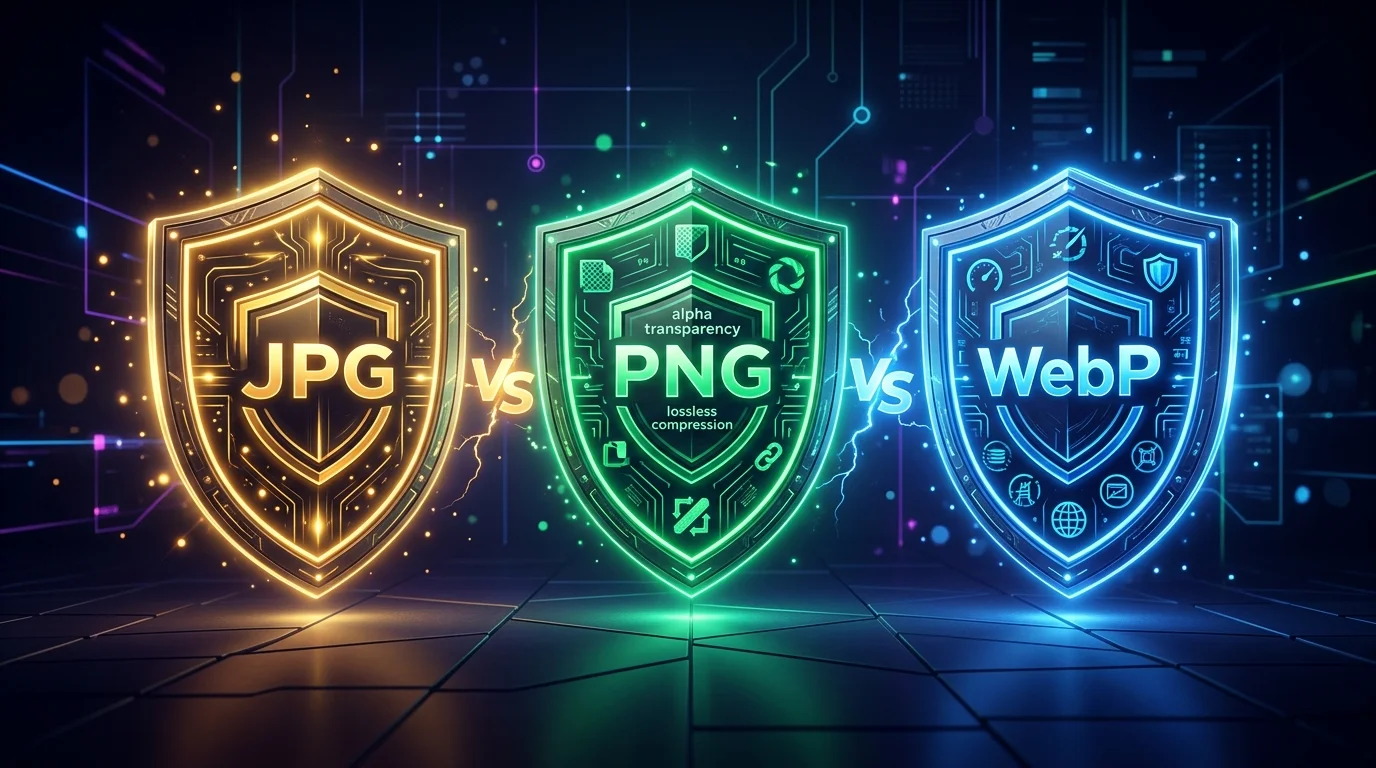
Every few years the "which image format should I use?" question resurfaces, and every few years the answer shifts slightly. In 2026 the landscape is more settled than it used to be — WebP has near-universal browser support, AVIF is gaining ground, and JPG and PNG still aren't going anywhere. But "just use WebP for everything" is an oversimplification that will burn you in specific, predictable situations. Here's how the formats actually compare when you stop reading spec sheets and start measuring real files.
JPG: still the default for photographs
JPG has been the workhorse of web photography since the 1990s, and for good reason: it handles complex, high-color-count images (landscapes, product shots, portraits) better than almost any format at equivalent file sizes. Its lossy compression is tuned specifically for photographic content, and at quality levels between 75 and 85, the artifacts it introduces are virtually invisible to the naked eye.
Where JPG falls apart is anything with hard edges, flat colors, or transparency. Logos, screenshots, and text-heavy graphics rendered as JPGs develop visible ringing artifacts around sharp boundaries — the kind of halo effect that makes text look fuzzy and icons look cheap. If your image has any of these characteristics, JPG is the wrong choice regardless of file size.
PNG: lossless quality and transparency
PNG's strength is precision: it compresses without discarding any data, which means what you save is exactly what you get back. That makes it the correct choice for screenshots, UI mockups, logos, diagrams, and anything where every pixel matters — especially if the image contains transparency (alpha channel), which JPG doesn't support at all.
The trade-off is file size. A PNG photograph can easily be five to ten times larger than a JPG at comparable visual quality, because PNG's lossless compression simply can't compete with JPG's lossy approach for high-complexity photographic content. Using PNG for product photos or hero images is one of the most common and most expensive performance mistakes on the web.
WebP: the best of both worlds (mostly)
WebP supports both lossy and lossless compression, transparency, and even animation — essentially combining the strengths of JPG, PNG, and GIF into one format. In direct comparisons, lossy WebP typically produces files 25–35% smaller than JPG at equivalent visual quality, and lossless WebP beats PNG by a similar margin.
Browser support, once WebP's biggest weakness, is now essentially universal. Every major browser — Chrome, Firefox, Safari, Edge — has supported WebP for years. The remaining edge cases are legacy email clients and certain native mobile apps that still choke on WebP attachments, but for anything served on the web, compatibility is no longer a real concern.
The one area where WebP doesn't clearly win is encoding speed. WebP compression is noticeably slower than JPG, which matters if you're processing thousands of images in a pipeline — but for the typical use case of optimizing a handful of images before publishing, the difference is irrelevant.
AVIF: the next contender
AVIF pushes compression efficiency even further than WebP, often producing files 30–50% smaller at equivalent quality. It supports HDR, wide color gamut, and transparency. But support is still incomplete — older Safari versions and some mobile browsers don't handle it well, and encoding is significantly slower than both JPG and WebP.
For most projects in 2026, AVIF is worth using as a progressive enhancement (serve AVIF to browsers that support it, WebP or JPG as a fallback) rather than a primary format.
When to use each format
- Photographs, hero images, product shots → WebP (lossy) for web delivery, JPG as a universal fallback.
- Screenshots, logos, diagrams, UI elements → WebP (lossless) or PNG. Use PNG when you need guaranteed compatibility outside the browser.
- Transparency required → WebP or PNG. Never JPG.
- Email attachments and offline documents → JPG or PNG. Many email clients still don't render WebP inline.
- Maximum compression, modern stack → AVIF with WebP/JPG fallback.
The practical takeaway
If you're picking one format and don't want to think about it, WebP is the safest default for web content in 2026. It handles photos and graphics equally well, supports transparency, and produces smaller files than either JPG or PNG. Use JPG when broad offline compatibility matters, PNG when lossless pixel-perfect output matters, and AVIF when you have the infrastructure for format negotiation and want every last byte of savings.