

Editing a PDF in Your Browser: How a Client-Side PDF Editor Actually Works
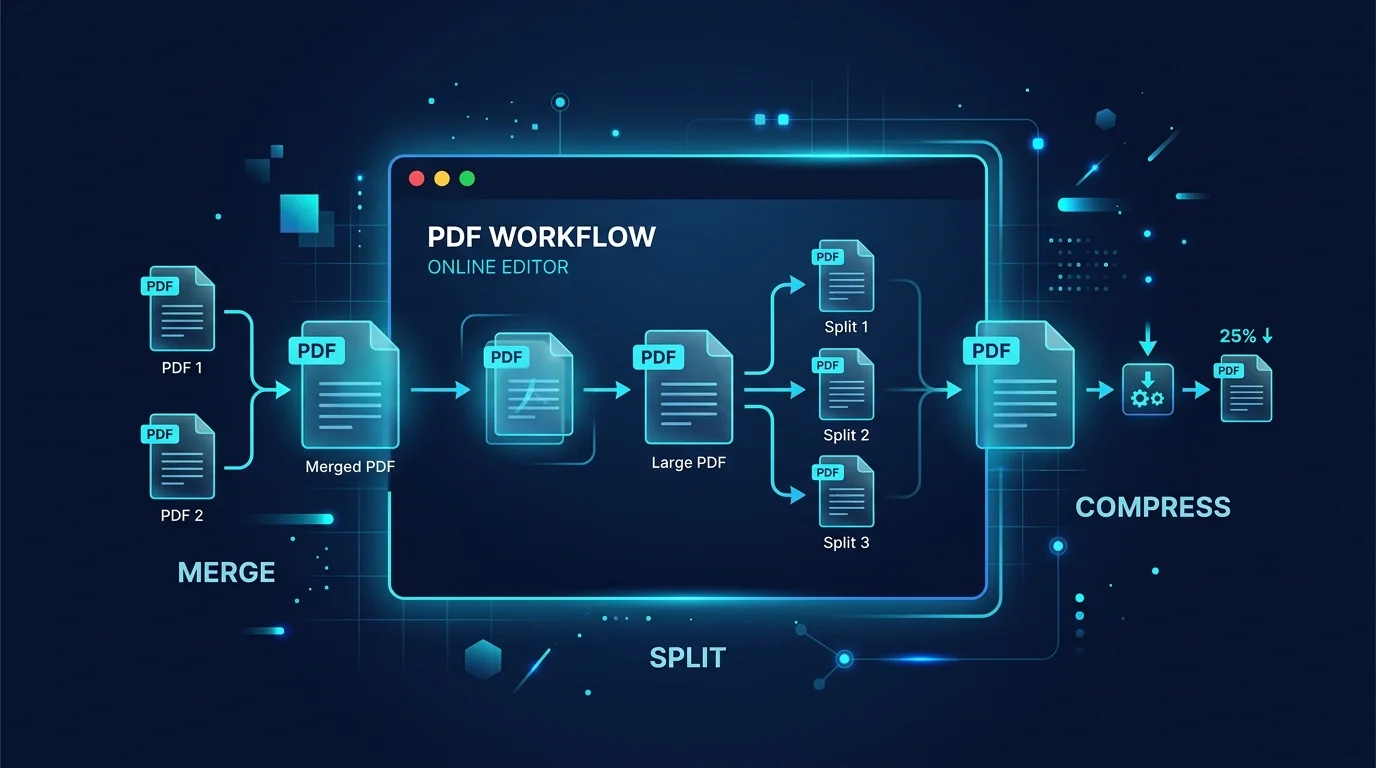
Most online PDF editors work the same way: you upload your file, a server somewhere modifies it, and you download the result. That is fine for a flyer. It is a harder sell for a signed contract, a payslip, or a medical form. A client-side editor flips the model — the PDF is opened by your browser, edited in memory, and written back out on your machine. Nothing is uploaded, so there is no page cap, no hourly quota, and no file sitting on someone else's disk waiting to be deleted.
That design decision shapes everything the editor can and cannot do. Here is the honest version — and if you would rather just try it, the free online PDF editor is open and needs no account.
Adding text, and editing text that is already there
Adding new text is straightforward: you click on the page, type, and the editor places a text object at that position with the font, size, and colour you picked. Because the geometry is stored in PDF points rather than screen pixels, the result lands in exactly the same spot whether you were zoomed to 50% or 400% when you placed it.
Editing existing text is the interesting case. A PDF does not store paragraphs — it stores instructions to draw glyphs at coordinates. There is no "sentence" to rewrite. So a browser-based editor covers the original span with a white rectangle and drops a new, editable text object on top, pre-filled with the original string, font, size and colour. Visually it is identical, and it is how essentially every editor that does not have a server-side PDF engine handles the problem.
Two consequences worth knowing:
- Whiteout is not redaction. The original text is still inside the file and can be recovered by anything that reads the content stream. If you need text to be genuinely gone, use a redaction tool that removes it, not an editor that paints over it.
- Scanned pages have no text to edit. A photo of a document is an image. Run OCR over it first to produce a text layer, then edit.
Fonts are the part everyone underestimates
Type a name in Greek, an address in Thai, or a product code with a smart quote into a PDF built around Helvetica, and you get missing glyphs — squares, blanks, or a silently dropped character. The standard PDF base fonts cover a narrow slice of Latin and nothing else.
A serious editor solves this by embedding a font that actually covers the script you typed, and by subsetting it so you are not shipping a 20MB face to render six words. Being able to upload your own font matters for the same reason: brand typefaces and less common scripts are never in a default list.
Forms, signatures, and stamps
Filling an existing AcroForm is a different operation from drawing text on a page — the editor writes values into the form fields the document already defines, so checkboxes stay checkboxes and the file remains a form. Adding your own fields is useful when you are the one distributing the document.
Signatures and stamps are, mechanically, just image or vector objects placed on a page. Draw one once, reuse it across documents. Worth being clear-eyed: this is a visual signature, not a cryptographic one. If a counterparty requires a digitally signed PDF with a verifiable certificate, a drawn squiggle will not satisfy them.
Page-level work
Reordering, rotating, deleting, and inserting pages happens above the content layer, so it composes cleanly with everything else you have added. The typical real workflow is a mix: drop the two blank scanned pages, rotate the one that came in sideways, whiteout a wrong date, type the right one, sign the last page, export.
What client-side editing genuinely cannot do
- Reflowing text. Delete a sentence in the middle of a paragraph and the rest will not close the gap. PDFs have no paragraph model to reflow.
- XFA forms. A dying Adobe-specific format that is effectively a separate application embedded in a PDF wrapper.
- Very large files on modest hardware. Everything is in memory, so a 500MB scanned archive will strain a laptop in a way a server would not.
A practical checklist before you export
- Zoom to 100% and read every page you touched — whiteout rectangles that are a shade off are obvious in print and invisible on screen.
- Check any non-Latin text actually rendered, rather than assuming it did.
- If the document is going to a printer, export and reopen the result before sending it, not after.
- If something in it was meant to be secret, redact — do not whiteout.
The trade-off is simple. A server-side editor can do operator-level surgery on a content stream; a browser-based one cannot. In exchange, your file never leaves the machine it started on, which for most documents worth editing is the better deal.
Open the PDF editor and drop a file on the page to start — nothing is uploaded, and there is no page or hourly limit.